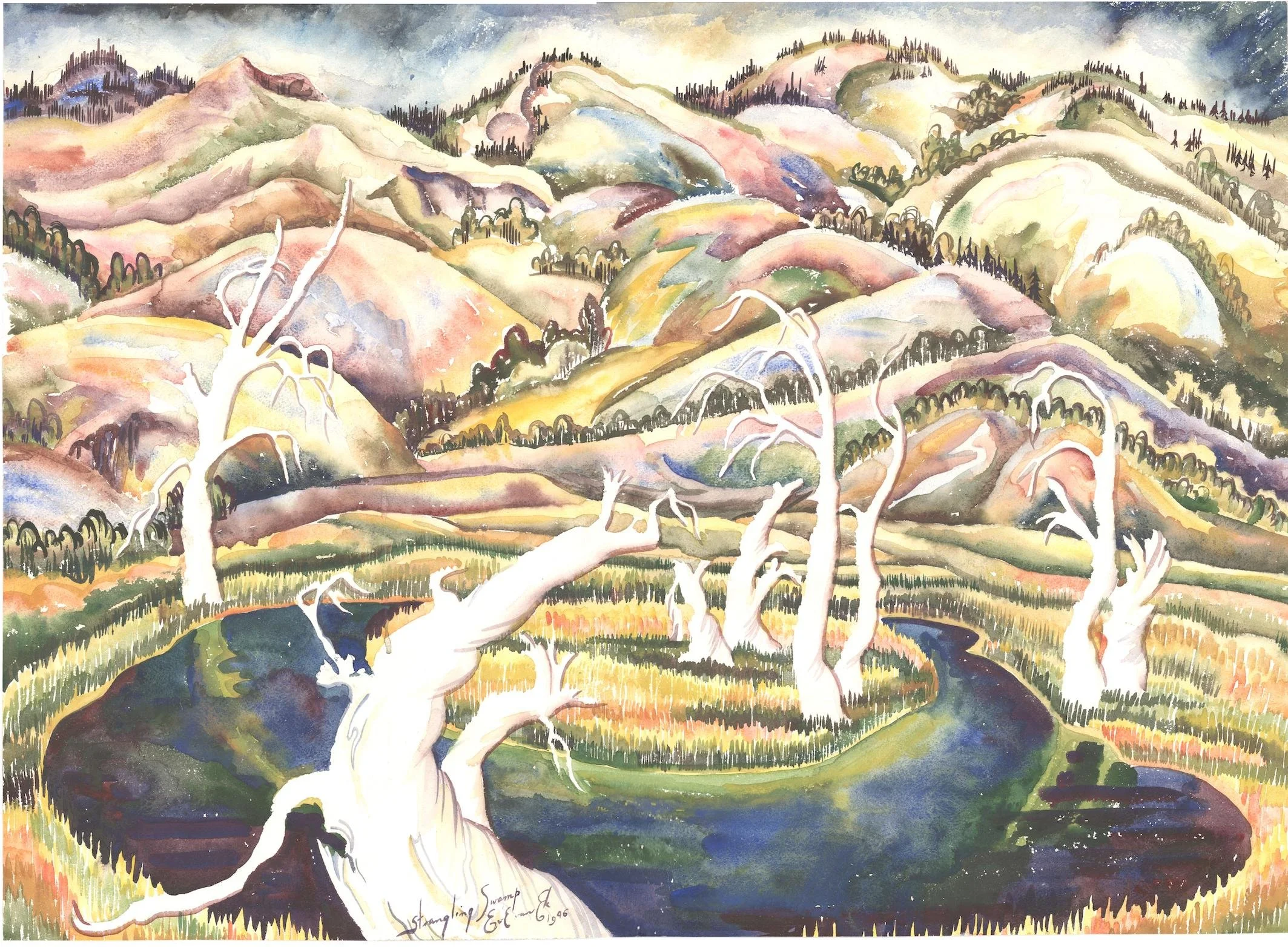
Art for All: The Cedar City Art Exhibit, 1940 - 2008
Southern Utah Museum of Art October 18, 2025 - March 7, 2026
In 1940, a visionary junior high school art teacher, Eugene Jorgensen, proposed the idea to initiate an annual community art exhibition featuring the work of selected local, regional, and national artists. The Cedar City Art Committee was born to coordinate this invitational show, which was hosted yearly until 2008. The Cedar City Art Exhibit is the source of many artworks acquired by Southern Utah University, now held in the collection of Southern Utah Museum of Art (SUMA); but at least one artwork was selected each year to be purchased for the city, and as the event evolved, students would save money and seek to buy art for their schools. This exhibition highlights some of the most important pieces originating in the annual art exhibit—including nationally-recognized artists like Maynard Dixon, regional favorites like Eve Drewelowe, and notable Utah artists such as Jimmie Jones—from the collections of both SUMA and the Iron County School District.
But the Cedar City Art Exhibit not only exemplifies this community’s commitment to the arts and its pride in an artistic heritage—its origins also illuminate an important moment in American history when New Deal-sponsored programs sought to bring art to all Americans. Like four other projects in Utah, the Cedar City Art Committee was initially funded by the Federal Art Project’s Community Art Center Program, which was launched to open the world of art to every citizen. The broad accessibility of art and arts education had a democratizing effect, demonstrating that art is useful and fundamental in a very practical sense. In their apparent press release from 1941, the Cedar City Art Committee encapsulated their mission—and that of all similar programs—simply and beautifully: “The art patrons of Cedar City have gone to considerable expense…to bring the exhibit and show it free to the public because they believe art is for all.”
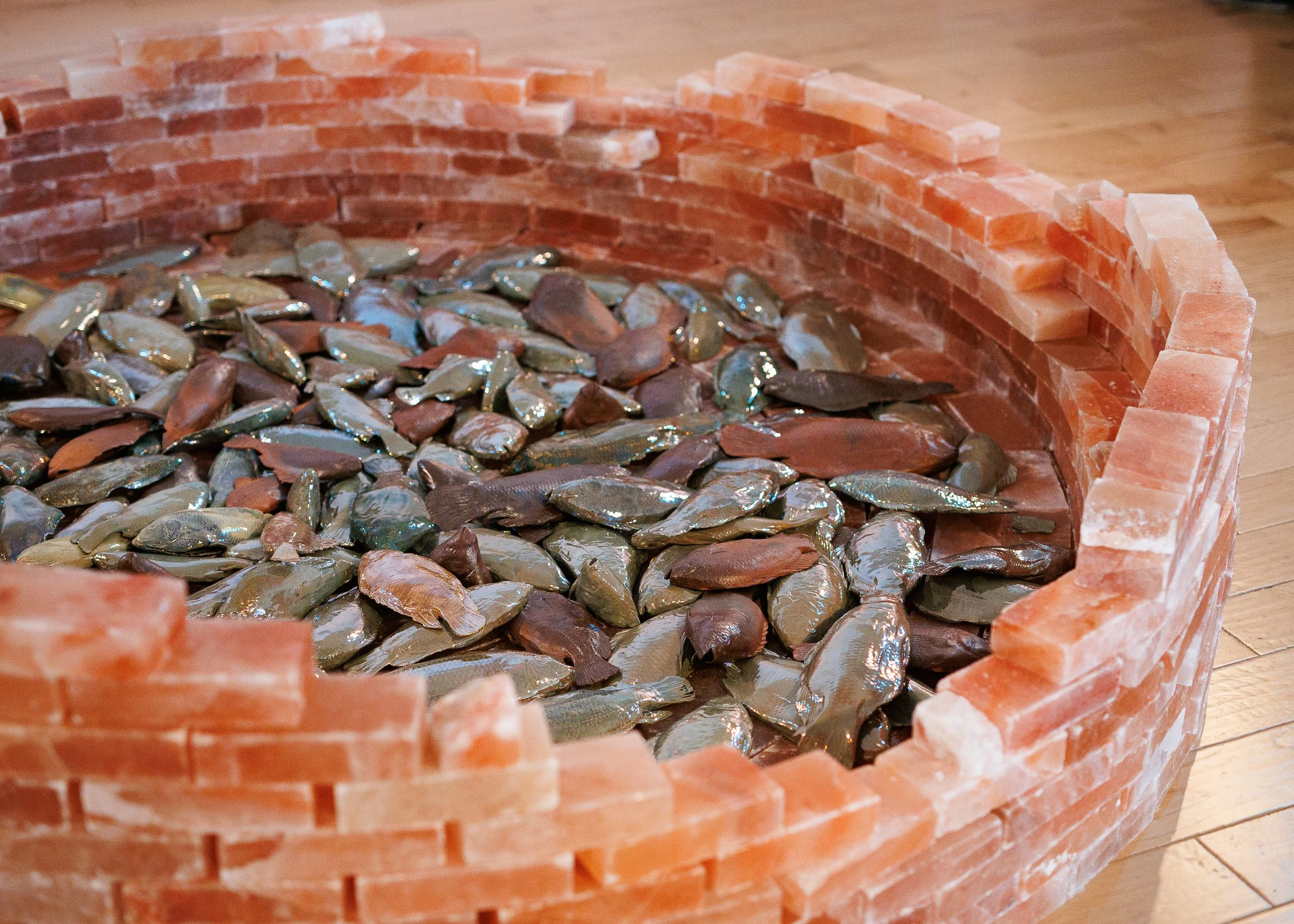
Himali Singh Soin (India, b. 1987), Piscean Premonition, 2024, Glazed ceramic, salt-fired terracotta, and Himalayan salt bricks, Courtesy of the Artist.
Salt Lines: Exploring Climate, Environment, and the Saline Influx
Southern Utah Museum of Art October 19, 2024 - March 8, 2025
Salt lines mark the merging of saltwater and freshwater, where river meets sea. Migrations, manipulations, and transmutations of saltwater and saline bodies, however, have transformed salt into both the maker and marker of climate change. Salt lines now form the boundary between present crisis and future disaster—a line that we as humans are dangerously close to crossing. In Salt Lines: Exploring Climate, Environment, and the Saline Influx, the past, present, and future of salt in our local landscape and global community are examined across three bodies of work that employ multiple media.
Two immersive installations by Hylozoic/Desires, a multimedia performance duo featuring Himali Singh Soin and David Soin Tappeser, form the heart of the exhibition, tracing salt lines across time and space, and into an imagined future. Namak Nazar, an aural sculpture that takes the form of a “pillar of salt,” employs science, myth, and history to express both the doom of climate change and the redemption of inward reflection. Their Piscean Premonition, on the other hand, creates an archaeological site for future humans. Serving as prophets of a precarious planetary moment, salt-glazed ceramic fish made of local materials and created with local collaborators evoke mass extinction along salty shorelines. Photographic works by noted aerial photographer David Maisel and Utah-based artist Alexandra Fuller casting Great Salt Lake as their subject provide a backdrop for Hylozoic/Desires’ installations and anchor them within a local crisis. These photographs locate the exhibition within the larger conversation surrounding Utah’s saltwater body, where extreme changes endanger its delicate ecosystems and imperil nearby human habitation.
Through the different artistic perspectives and access points presented, Salt Lines can inspire solidarity across geographic distance, connecting the plight of humans—particularly those inhabiting similar desert environments and working within agricultural economies—as they face a future defined by climate events.
Like Water in a Vessel: The Ceramic Art of Kelvin Yazzie
Southern Utah Museum of Art June 1 - September 28, 2024
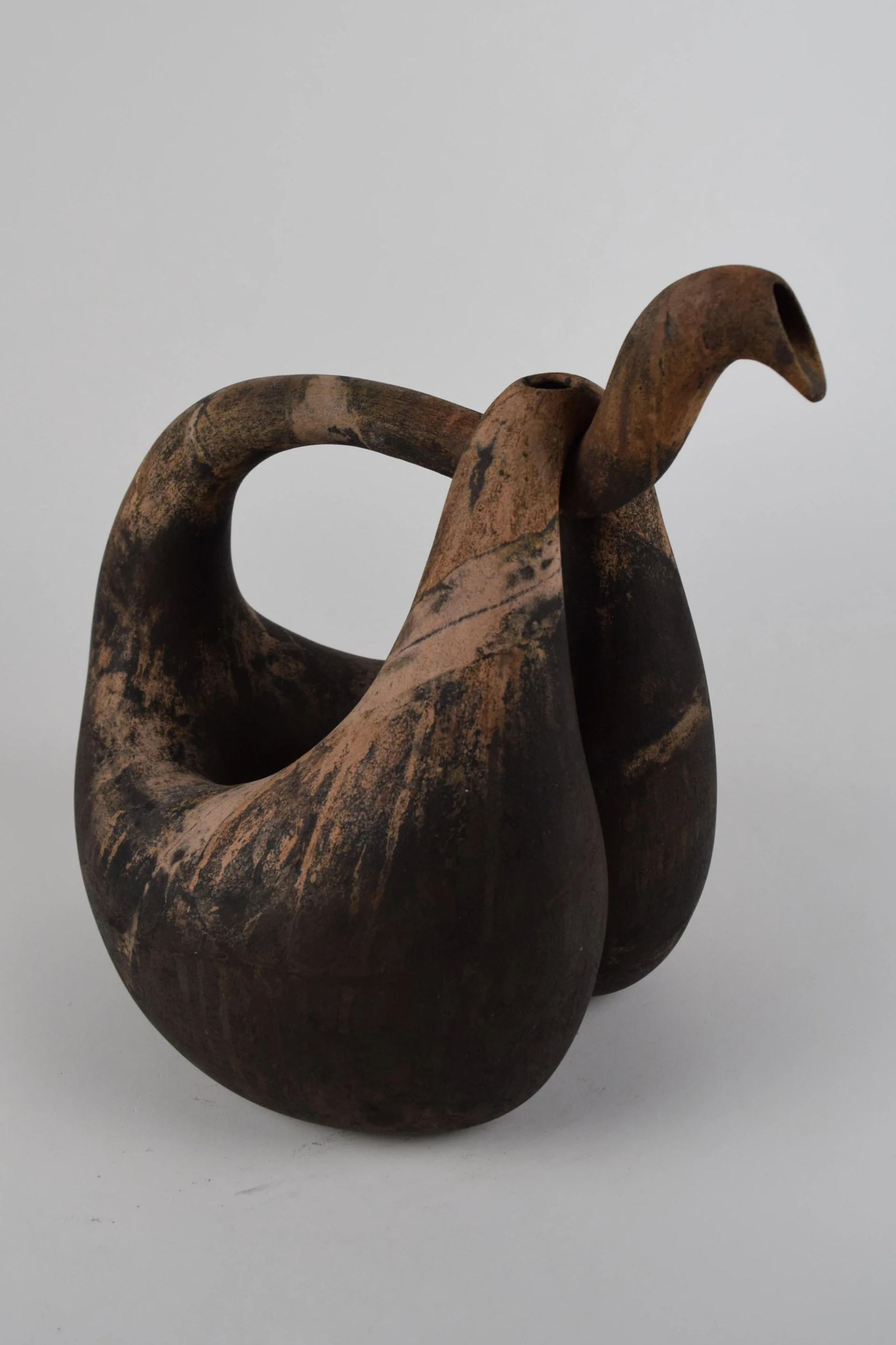
Ceramic artist and SUU alumnus, Kelvin Yazzie (Diné (Navajo), b. 1954), creates pots that swoop and swerve and swell in serpentine curves, voluminous chambers, and twisted knots. His works are deeply biographical, drawing on his childhood on the Navajo Reservation playing with mud and sheep entrails; reflecting his relationships with family, academic mentors and artistic collaborators; and exploring his mindful navigation of sobriety and American politics. Yazzie’s fluid containers that play with volume and emptiness not only evoke the dynamic movement of water, but also embody something of the artist’s character and values: water is formless, taking the shape of the vessel it fills, and thus exemplifies the power of adaptability, the potential for growth, and strength in change.
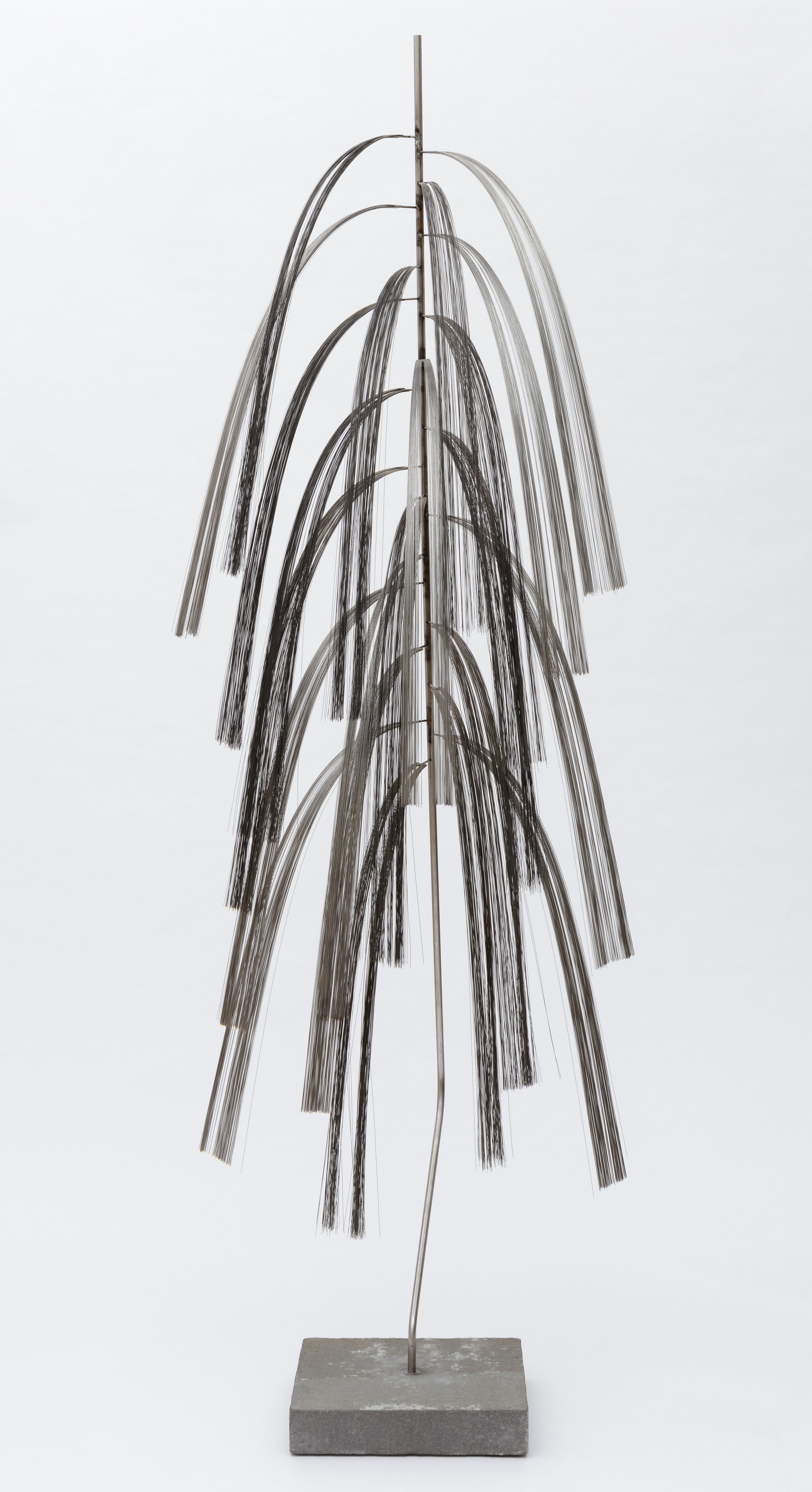
Harry Bertoia (U.S., b. Italy, 1915–1978), Untitled, c. 1965, stainless steel wire on stone base (not original), 84 x 48 x 48 in., Collection of Celia Bertoia (Washington, UT), S.BW.1
Harry Bertoia: Master Modernist
Southern Utah Museum of Art June 1 - September 28, 2024
Well-known for his sculptural furniture, Harry Bertoia (U.S., b. Italy, 1915-1978) was a prolific artist-designer of the modernist period, whose work traverses media and transcends categorization. Throughout his forty-year career, Bertoia was known to experiment with materials and play with techniques, often shifting between two-dimensional and three-dimensional projects over the course of a day. Harry Bertoia: Master Modernist is a celebration of the breadth of this pioneering artist’s body of work. Drawing from the collections of Celia Bertoia and the Harry Bertoia Foundation, this exhibition brings together objects that represent the diversity of his creative process. In addition to a multiplicity of sculptures and monotype prints that feature both abstract and organic designs, Bertoia’s so-called tonal or sonambient sculptures, which use sound as a sculptural material, transform the gallery into an ambient sonic environment.

Artist's Rendering of SUSC Administration Building (SUU's Bennion Building), completed 1973, L. Robert Gardner (Courtesy of L. Robert Gardner Collection, SUU Special Collections and University Archives)
L. Robert Gardner: Cedar City Mid-Century Modern
Southern Utah Museum of Art October 14, 2023 - March 2, 2024
When L. Robert Gardner (1918-1992) returned to his hometown of Cedar City in 1948 to open his own architecture practice, he was the only licensed architect between Las Vegas and Salt Lake City. He had graduated from MIT and cut his teeth in northern Utah, but ultimately Gardner made his mark across the southern part of the state and bordering regions, designing dozens of residential, institutional, and commercial structures over the course of four decades. A product of his time, Gardner designed buildings that exemplify mid-century modernism, contributing to the suburban development of rural Cedar City. Drawing from Gardner’s expansive archive, held in Southern Utah University’s Special Collections, this exhibition illuminates the profound impact of L. Robert Gardner on the built environment and architectural history of the university and its wider community. A selection of his campus, residential, commercial, and civic buildings serve not only to demonstrate the breadth of his work and its impact but also to illustrate the key attributes of mid-century modern architecture.
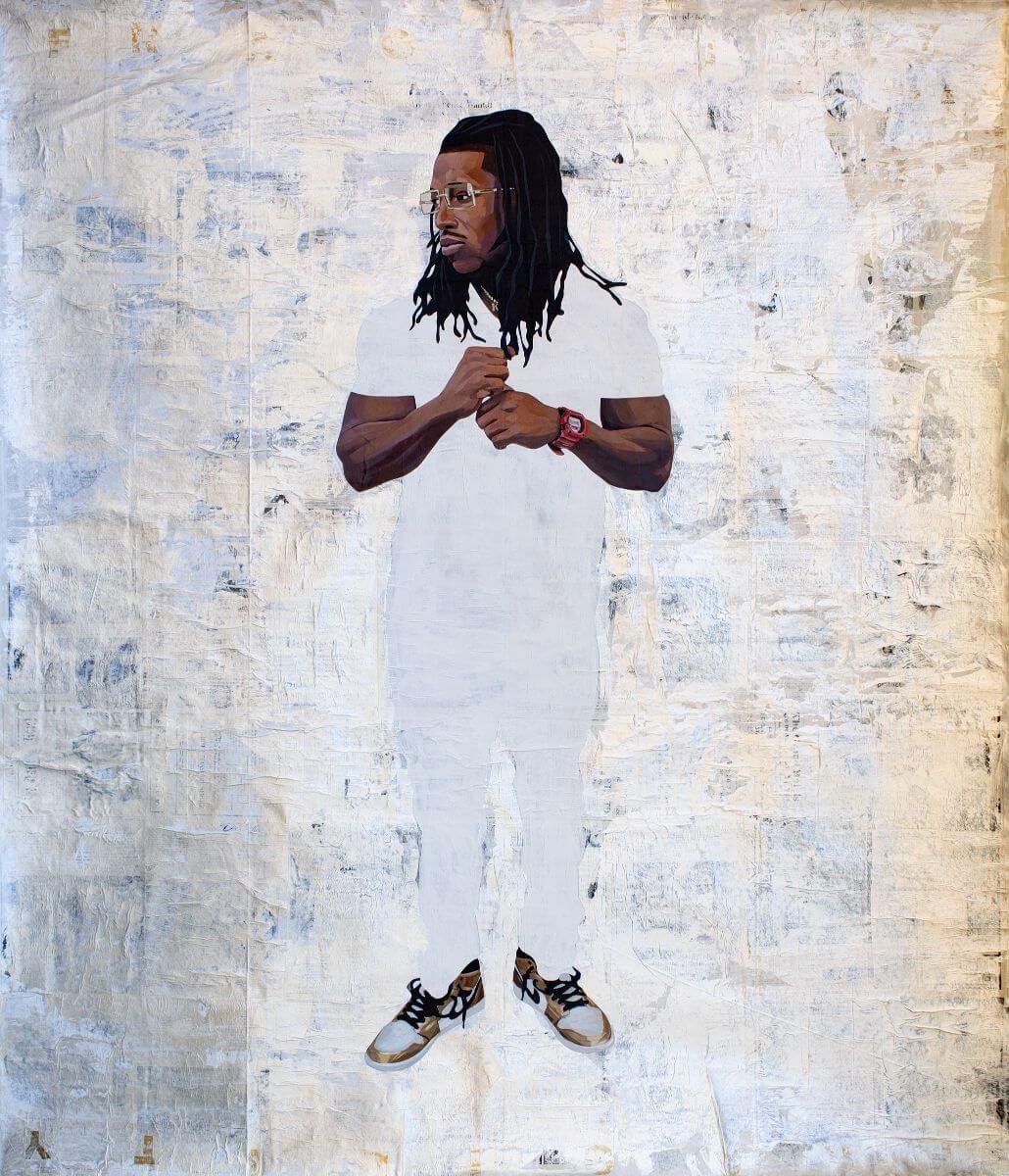
Vitus Shell, Ice Cream Man: White Fragility, 2021, Mixed media, Courtesy of the Artist.
A Dream Deferred: New Perspectives on Black Experience in the Work of Aïsha Lehmann and Vitus Shell
Southern Utah Museum of Art June 10 - September 23, 2023
In connection with Utah Shakespeare Festival’s production of A Raisin in the Sun, SUMA engaged two artists–Aïsha Lehmann and Vitus Shell—to contribute works that reflect and respond to the themes of the play, and express how they reverberate into the present. Lehmann created a new body of work that centers on the intersections of race, health, and societal opportunity across America, during the time of the play and today. Drawing on the data visualizations W. E. B. Du Bois created to explain the circumstances of Black Americans for the 1900 Paris World Fair, Lehmann overlays demographic information onto maps of U.S. cities and the state of Utah. Her infographics offer a profound education on how systemic racism affects populations of color in different ways across the country. The contradiction of these harsh realities with the gentle aesthetic of her prints only intensifies their message. Vitus Shell’s Ice Cream Man series features a Black man against collaged white backdrops, from which expressions like “Fragility,” “Guilt,” and “Rage” subtly emerge.
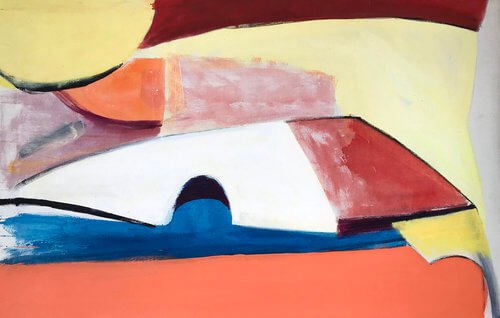
Louis Ribak, Blue Peach Abstract, c. 1960, Oil on canvas, Courtesy of Modern West Fine Art, SLC.
The Space Between: Visions of the Southwest
Southern Utah Museum of Art June 4 - September 24, 2022
The infinitely expansive horizons and ruggedly majestic terrain of the Southwest’s high deserts have enraptured generations of artists. For Indigenous artists, traditional materials, forms, and symbols connect their original work to their ancestral lands. For many transplanted artists, on the other hand, immersion in this enchanting landscape has inspired departures from convention and new experimentations with color and abstraction. The Space Between brings together works from four artists who represent the past, present, and future of abstract art forged in the creative crucible of the desert: Louis Ribak (American, b. Lithuania, 1902-1979) and Beatrice Mandelman (American, 1912-1998), the groundbreaking forces behind Taos Modernism; and Arlo Namingha (American, Tewa/Hopi, b. 1974) and Shalee Cooper (American, b. 1978), two exciting contemporary artists who embody the enduring legacy of their predecessors and the new visions emerging from this environment. Echoing the dynamism of the desert, these artists engage space, shape, and scale in parallel but different ways, each finding meaning where these elements meet and in the spaces between.

Buddha Amitabha (S1997.28), Courtesy of Arthur M. Sackler Gallery of Art
Encountering the Buddha: Art and Practice Across Asia
National Museum of Asian Art October 14, 2017 - January 17, 2022
This exhibition brings together more than two hundred artworks, spanning two millennia, to explore Asia’s rich Buddhist heritage. These pieces represent the diverse schools that arose from the Buddha’s teachings, and the manifold ways that Buddhists have utilized and interacted with objects as part of their practice. Two immersive spaces—a Tibetan Buddhist shrine room and a film installation centered on a stupa in Sri Lanka—as well as various interactive stations allow visitors to delve deeper into the meaning of the artworks and their place within the Buddhist communities they served. (Co-curated with Debra Diamond & Robert DeCaroli)
Human Currents: The World’s Largest Pilgrimage as Interpreted by Hannes Schmid
The Rubin Museum of Art July 22 - November 13, 2011
From January to February 2001, tens of millions of pilgrims assembled in Allahabad, North India for the Maha Kumbh Mela festival, held only once every one hundred forty-four years. Photographer Hannes Schmid was there as these pilgrims of all ages, castes, and classes from every corner of India gathered by the banks of the sacred Ganges River, capturing this massive act of faith on film, both still and moving. Schmid’s large, color photographs and aerial-angled movie bring to life the claustrophobic crowds, myriad colors, and energy of this greatest of Hindu pilgrimages.

Photograph by David De Armas; Courtesy of Rubin Museum of Art

Photograph by David De Armas; Courtesy of Rubin Museum of Art
Patterns of Life: The Art of Tibetan Carpets
The Rubin Museum of Art April 8 - August 22, 2011
This exhibition presents the variety of styles, motifs, and functions of Tibet carpets, an important artistic tradition that serves aesthetic and practical purposes in both monastic and domestic spheres. The visual language shared between Tibetan decorative art and fine art is explored through complementary paintings and sculptures from the museum’s collection.
Body Language: The Yogis of India and Nepal
The Rubin Museum of Art January 28 - July 4, 2011
Sadhus, the vividly decorated or completely nude wandering ascetics of Hinduism, are the subject of striking photographs by Thomas Kelly in this exhibition. Sadhus use their body like a canvas for telling stories, using colors and symbols to represent esoteric inner visions and higher states of consciousness while also expressing their religious identities. Their markings, called tilakas, can range from a simple daub of color to fantastically complex designs utilizing the entire face and body. Body Language focuses on the rich symbolism behind sadhus’ painted bodies, postures and practices.

Photograph by Thomas Kelly

Photograph by David De Armas; Courtesy of Rubin Museum of Art
A British Life in a Mountain Kingdom: Early Photographs of Sikkim and Bhutan
The Rubin Museum of Art August 6, 2010 - January 10, 2011
This is the first exhibition of photographs by John Claude White, presented in original prints and large-scale reproductions from two important albums on view. A British government officer and civil engineer, White spent much of his career stationed in places that one hundred years ago were, and to an extent still remain, shrouded in a certain veil of mystery: India, Nepal, Sikkim, Tibet and Bhutan. He was a pioneer of mountain photography, spending weeks at a time visiting every corner, trekking every valley, and climbing every mountain pass in Sikkim, all the while photographing his official and personal explorations there and in Bhutan.
Tradition Transformed: Tibetan Artists Respond
The Rubin Museum of Art June 11 - October 18, 2010
This is the first exhibition of contemporary Tibetan art in a New York City museum. The nine Tibetan artists featured each explore contemporary issues—personal, political, and cultural—by integrating the centuries-old traditional imagery, techniques, and materials found in Tibetan Buddhist art with modern influences and media. Trained in traditional painting and the strict interpretations prescribed by Buddhist religion, these artists break the spiritual formulas and artistic norms by experimenting with alternative media and extracting sacred symbols from their religious context, repurposing them for self-expression. (Co-curated with Rachel Weingeist)

Photograph by David De Armas; Courtesy of Rubin Museum of Art
ADDITIONAL EXHIBITIONS
Feb - July 2010 In the Shadow of Everest: Photographs by Tom Wool, Rubin Museum of Art, New York
Dec 2009 - May 2010 Visions of the Cosmos: From the Milky Ocean to an Expanding Universe (co-curator, Hindu and Jain Cosmologies), Rubin Museum of Art, New York
Sept 2009 - Feb 2010 Victorious Ones: Jain Images of Perfection (in-house curator), Rubin Museum of Art, New York
Dec 2008 - May 2009 Color and Light: South Asian Embroidery (in-house curator), Rubin Museum of Art, New York
Oct - Dec 2008 A Shower of Jewels: Wealth Deities from the Rubin Museum of Art, Oglethorpe University Museum of Art, Atlanta
Sept - Dec 2008 Buddha in Paradise: Tibetan Art from the Rubin Museum of Art, Robert Hull Fleming Museum at the University of Vermont
May - Aug 2008 Buddha in Paradise, Rubin Museum of Art, New York
April - Aug 2008 Earthly Immortals: Arhats in Tibetan Painting, Rubin Museum of Art, New York
Oct 2007 - April 2008 Bon: The Magic Word (contributing writer), Rubin Museum of Art, New York